Claude Octopus: Multi-Provider Orchestration for Claude Code
How a Claude Code plugin coordinates eight AI providers with consensus gates to catch blind spots before code ships.
Every model has blind spots. I’ve watched Claude produce clean architecture and completely miss a null check. GPT caught the null check but wanted to pull in a dependency I’d never heard of. Gemini flagged both problems and then suggested a fix that didn’t compile.
Claude Octopus asks a simple question: what if you made them check each other’s work?
What it does
It’s an open-source Claude Code plugin. You give it a task, it fans the query out to multiple AI providers in parallel, and it won’t proceed unless 75% of them agree on the approach. When three out of four providers line up, it moves forward. When they disagree, it stops and shows you where they diverge.
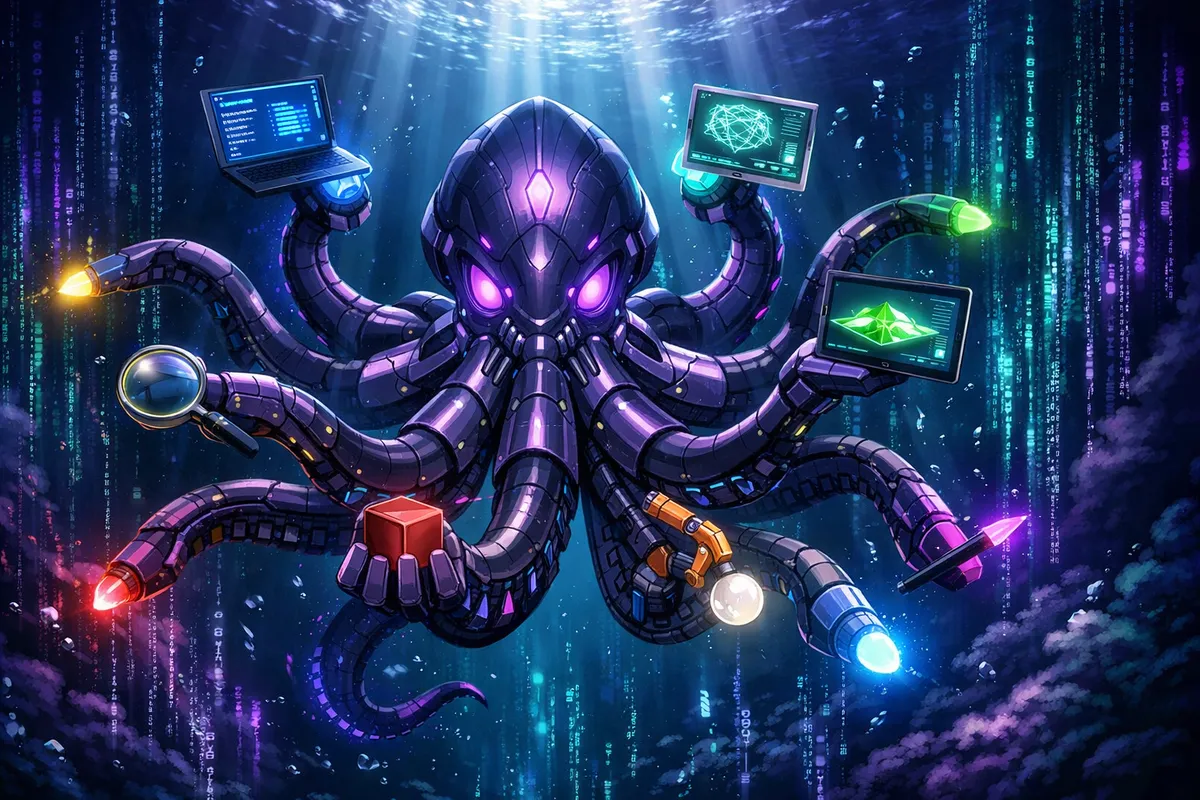
Eight arms, eight providers. The metaphor does the heavy lifting here.
The eight arms
You don’t need all eight. Claude alone runs every persona and workflow. The multi-provider stuff kicks in as you connect more models.
| Provider | Primary role | Cost |
|---|---|---|
| Claude (built-in) | Orchestration, consensus | Included |
| Codex / OpenAI | Architecture, code patterns | API key |
| Gemini / Google | Alternatives, security review | API key |
| Perplexity | Live web search, CVE lookups | API key |
| Qwen / Alibaba | Backup research | 1,000-2,000 free requests/day |
| Copilot / GitHub | Zero-cost research | Existing subscription |
| Ollama (local) | Offline, privacy-preserving | Free |
| OpenRouter | Access to 100+ models | Pay-per-model |
Three or four providers feels like the sweet spot. Enough to surface real disagreements without turning every task into a committee meeting.
The Double Diamond
Tasks move through four phases, borrowed from the UK Design Council’s Double Diamond:
Discover → Define → Develop → Deliver
Quality gates sit between each phase. A code review might discover issues across providers, define which ones are real concerns through consensus, develop fixes, and deliver them as a PR, with validation at each transition.
You pick how much autonomy the system gets:
- Supervised requires approval at each gate
- Semi-autonomous only stops for significant decisions
- Dark Factory takes a spec and produces software with no human in the loop
Most teams will start supervised. Dark Factory is there when you’re ready for it, which might be never, and that’s fine.
What ships with it
Beyond the multi-provider coordination, there’s a lot packed in.
The plugin includes 32 specialist personas (security auditor, database architect, frontend developer, TDD orchestrator, among others). Each persona gets its own tool access and workflow preferences, not just a different system prompt.
There are 49 slash commands. The ones I reach for most:
/octo:embraceruns the full lifecycle, research through delivery/octo:factoryis the autonomous pipeline, spec in, software out/octo:debatestages a four-way AI debate with scoring/octo:securitydoes OWASP vulnerability scanning with remediation/octo:tddhandles red-green-refactor TDD
A reaction engine watches your GitHub activity. It forwards CI failure logs to agents, collects PR review comments, escalates stuck tasks after 15 minutes, and closes out work when PRs merge. All opt-in, configured through .octo/reactions.conf.
The smart router (/octo:auto) parses what you type and picks the right workflow. I end up using this more than the specific commands.
Getting started
Two commands:
claude plugin marketplace add https://github.com/nyldn/claude-octopus.gitclaude plugin install octo@nyldn-pluginsRun /octo:setup afterward and it detects which providers you already have configured. Only /octo:* commands activate the plugin; your existing Claude Code setup stays untouched.
To uninstall: claude plugin uninstall octo. No residual config left behind.
Trade-offs
The good parts:
- When models disagree, you learn something. That’s the whole point.
- Security reviews benefit from multiple perspectives. One model missing a vulnerability is common. Three missing the same one is less likely.
- You can start with just Claude and add providers when you feel like it. No upfront commitment.
- Namespace isolation means it won’t break anything you already have.
The parts that give me pause:
- Running four providers on every task multiplies your token spend. Not everything needs a consensus vote.
- 32 personas and 49 commands is a lot of surface area to learn. The smart router helps, but you’ll still spend time figuring out which workflow fits your situation.
- Three models agreeing doesn’t mean they’re right. It means they share similar training biases. The 75% threshold catches individual model failures, not systematic ones.
- Managing API keys, rate limits, and billing across providers is real operational work.
How it compares
The README puts it plainly: “Superpowers makes one agent work really well for hours. Octopus makes multiple agents check each other’s work.” Different problems. They can coexist.
If you’re happy with what a single model gives you and your work doesn’t need multi-perspective validation, the coordination layer adds complexity without enough payoff.
Verdict
At 916 commits and 2.4k stars, this is a big project with real scope. The multi-provider consensus idea is interesting and solves a problem I’ve actually run into: blindly trusting one model’s output on code that matters.
Whether it’s worth it depends on what you’re building. If you ship production code where a missed vulnerability costs real money, having three providers cross-check each other is cheap insurance. If you’re writing scripts and prototypes, it’s more machinery than the job calls for.
I’d suggest starting with Claude alone, adding a provider or two for the tasks where you actually want a second opinion, and seeing if the consensus gates catch things you would have missed. That’s probably how most people will use it.